
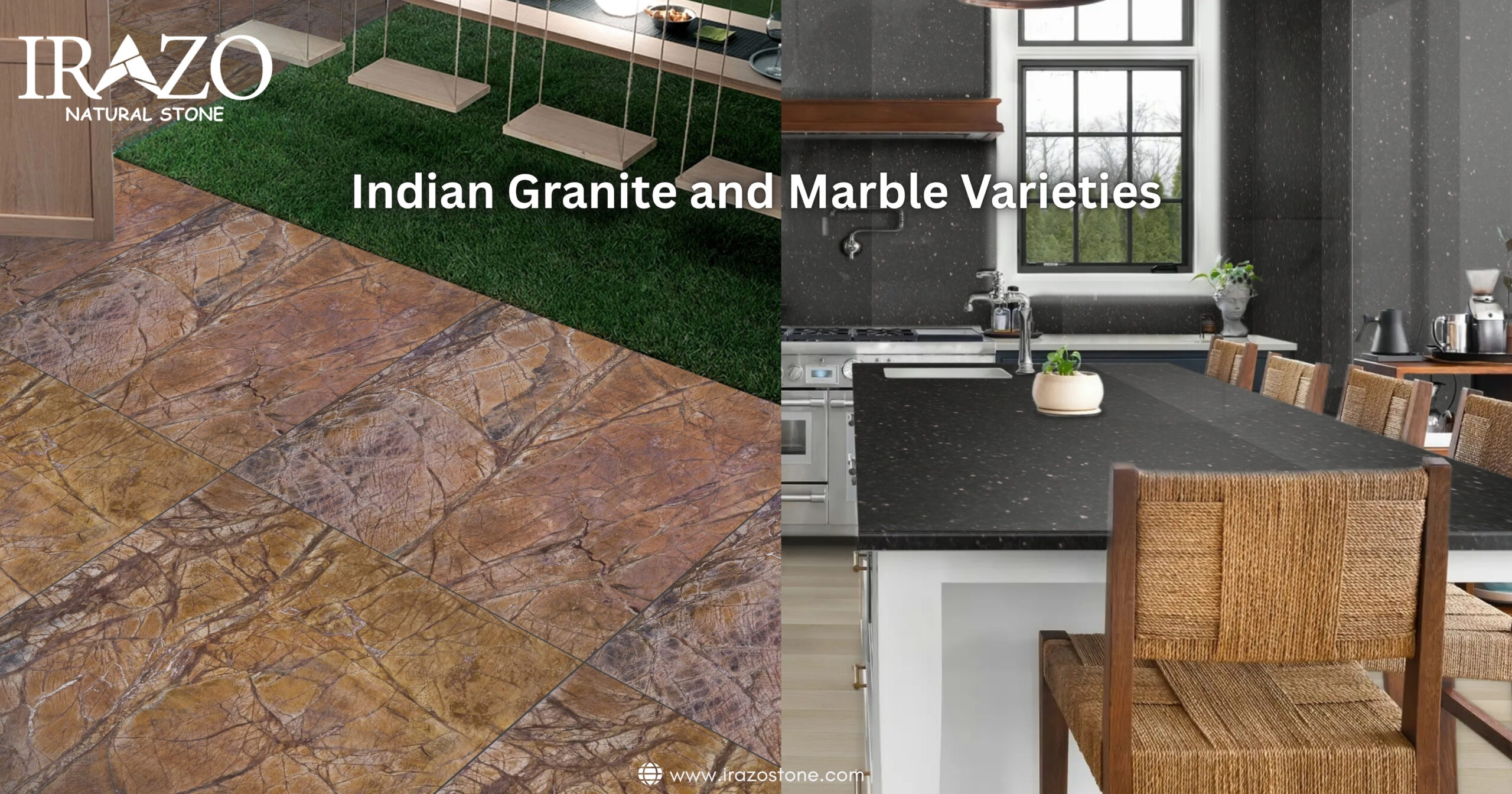
Indian granite and marble stand out as two of the most trusted natural stones for homes, offices, temples, and big buildings across India and the world. People choose them for floors, kitchen tops, walls, stairs, and monuments because they look beautiful and last for decades.
This guide covers every major variety, their colors, patterns, origins, technical details, how they get mined and cut, where to use them, and how they compare. You will find clear facts on hardness, strength, water absorption, and more, so you can pick the right stone for your needs.
What is Granite?
Granite is a natural igneous rock formed by the slow cooling of molten magma beneath the Earth’s surface.
Composition:
- Quartz
- Feldspar
- Mica
Density and Hardness:
- Bulk specific gravity: 2.6 to 2.8 g/cm³
- Compressive strength: 150-300 MPa
- Flexural strength: 10-25 MPa
- Hardness: 6-7 on Mohs scale
Water Absorption and Porosity:
- Water absorption rate: 0.1% to 0.4%
- Open porosity: Less than 1%
- Freeze-thaw resistance: Excellent
Thermal Properties:
- Heat resistance: Up to 1200°C
- Thermal expansion coefficient: 8-10 × 10⁻⁶/°C
- Thermal conductivity: 2.5-3.5 W/mK
Granite is mainly used where strength and long life are required.
What is Marble?
Marble is a metamorphic rock formed from limestone under heat and pressure.
Key Characteristics:
- Smooth surface
- Natural veins and patterns
- Softer than granite
- More porous
Technical Specifications (Indian Marble):
- Compressive Strength: 1100–1400 kg/cm²
- Water Absorption: 0.20–0.40%
- Thickness: 15–30 mm
Marble is mainly used for decorative and luxury interiors.
At Irazo Stone, we take pride in being the best manufacturer of granite and marble, offering a wide range of carefully processed stones suitable for homes, commercial spaces, and large architectural projects. With a strong focus on quality, precision cutting, and customer satisfaction, we ensure every slab meets the highest standards.
Looking for the perfect stone for your project?
Contact us today
Main Places Where Indian Granite and Marble Come From
Granite mostly comes from the south. Andhra Pradesh gives us Black Galaxy and Tan Brown. Telangana supplies Absolute Black from Khammam. Karnataka and Tamil Nadu produce Steel Grey, Vizag Blue, and Imperial Red. Rajasthan adds lighter shades like Alaska White in the north.
Marble belongs mainly to Rajasthan. Makrana in Nagaur district yields pure white stone. Udaipur and Rajsamand supply green and white varieties. Banswara offers purple tones. Jaisalmer gives yellow marble. Gujarat adds Ambaji white, and Madhya Pradesh sends Katni beige. These areas have the right rocks formed over ancient times, so the stones look consistent and strong.
Popular Indian Granite Varieties with Full Details
India offers more than 100 granite shades. Here are the most used ones with their looks, places of origin, technical points where known, and best uses.
Black Granite Varieties
Black Galaxy Granite: Sourced primarily from Ongole, Andhra Pradesh, Black Galaxy granite features a stunning star-like pattern of golden and white specks against a deep black background. properties:
- Water absorption: Less than 0.1%
- Compressive strength: 180-220 MPa
- Density: 2.75 g/cm³
Applications: Kitchen countertops, flooring, wall cladding
Absolute Black Granite: This premium granite from South India offers solid black consistency with minimal variation. Its technical specifications include:
- Porosity: 0.15-0.25%
- Flexural strength: 15-20 MPa
- Abrasion resistance: 25-30 Ha
- Finish options: Polished, honed, flamed
Black Pearl Granite: Characterized by its silver and grey speckles on a black base, this granite from Tamil Nadu provides:
- Compressive strength: 160-200 MPa
- Water absorption: 0.2-0.3%
- Thermal shock resistance: Excellent
- Slip resistance: 0.6-0.8 (wet conditions)
Black Galaxy: Deep black base covered in golden or copper specks like stars at night. From Ongole, Andhra Pradesh. Same hardness and low absorption. Great for feature walls, tabletops, and commercial lobbies. The flecks sparkle under light.
- Mohs hardness: 6–7 (very hard and scratch-resistant)
- Density: 2.63–3.05 g/cm³ (high density makes it strong and stable)
- Water absorption: 0.05%–0.5% (very low, resists moisture and stains)
- Abrasion resistance: Very high (does not wear easily under foot traffic)
Steel Grey: Even grey with fine grains. From Karnataka and Tamil Nadu. Tough and affordable. Suits heavy traffic floors, stairs, and office cladding.
Properties:
- Mohs hardness: 6–7 (tough and scratch-resistant)
- Density: Around 2.82–2.85 g/cm³ (solid and heavy for good stability)
- Water absorption: 0.1%–0.62% (low enough for most indoor and some outdoor uses)
- Abrasion resistance: High (suitable for busy areas)
Rajasthan Black: Dark black with subtle patterns. From Rajasthan mines. Used for monuments and outdoor steps.
Properties:
- Mohs hardness: 6–7 (durable and scratch-resistant)
- Density: High (typically 2.7–2.9 g/cm³ range for Indian black granites)
- Water absorption: Low (similar to other Indian blacks, under 0.5–0.6%)
- Polish retention: Excellent (maintains shine for long periods)
White and Light-Colored Granites
Kashmir White Granite: This popular granite from Karnataka features a white background with burgundy and grey speckles:
- Density: 2.65 g/cm³
- Compressive strength: 170-210 MPa
- Water absorption: 0.15-0.25%
- Chemical resistance: Excellent against acids and alkalis
Alaska White Granite is known for its pristine white appearance with subtle grey veining:
- Porosity: 0.2-0.4%
- Flexural strength: 12-18 MPa
- Thermal expansion: 8.5 × 10⁻⁶/°C
- Frost resistance: Superior
Colonial White Granite features a white base with grey and black mineral deposits:
- Compressive strength: 155-195 MPa
- Water absorption: 0.18-0.28%
- Abrasion resistance: 28-32 Ha
- Stain resistance: High
Colored Granite Varieties
Jhansi Red Granite: From Uttar Pradesh, this granite showcases rich red tones with black and grey crystals:
- Density: 2.68 g/cm³
- Compressive strength: 165-205 MPa
- Water absorption: 0.2-0.35%
- UV resistance: Excellent
Hassan Green: Granite Karnataka’s contribution to green granite varieties:
- Compressive strength: 175-215 MPa
- Porosity: 0.15-0.3%
- Chemical composition: High feldspar content
- Weather resistance: Outstanding
Vizag Blue Granite from Andhra Pradesh, featuring blue-grey tones:
- Flexural strength: 14-19 MPa
- Water absorption: 0.12-0.22%
- Thermal conductivity: 3.2 W/mK
- Durability rating: A+ grade
Bahama Blue: Light blue with silver specks, from Andhra Pradesh and Rajasthan.
Regional Distribution of Granite Quarries
South Indian Granite Belt
Andhra Pradesh and Telangana Stone Galleria identify these states as major granite producers:
- Active queries: Over 800
- Annual production: 15 million tonnes
- Major varieties: Black Galaxy, Vizag Blue, Steel Grey
- Export contribution: 35% of India’s granite exports
Karnataka
- Quarry locations: Bangalore, Mysore, Hassan, Tumkur
- Production capacity: 12 million tonnes annually
- Specialty: Multicolor and premium black granites
- Technical grade: Superior quality with low porosity
Tamil Nadu
- Major centers: Madurai, Salem, Chennai
- Annual output: 10 million tonnes
- Famous varieties: Paradiso, Multicolor Red, Coffee Brown
- Quality characteristics: High compressive strength, excellent finish
North Indian Granite Production
Rajasthan
- Quarry regions: Jalore, Jodhpur, Kishangarh, Makrana
- Production: 8 million tonnes per year
- Varieties: Crystal Yellow, Platinum White, Rajasthan Black
- Unique features: High silica content, superior hardness
Gujarat
- Active mines: 200+
- Specialty granites: Blue Dunes, Ivory Fantasy
- Technical advantages: Low water absorption, high durability
- Export quality: Premium grade for international markets
Popular Indian Marble Varieties with Full Details
Rajasthan produces the best marble in India. Stones here have fine crystals and take a high polish.
White Marble Family
- Makrana White (Pure White or Sangemarmar): Famous pure white with almost no veins. From Makrana, Rajasthan. Used in the Taj Mahal.
Water absorption is very low (under 0.4%).
Specific gravity over 2.5.
Hardness 3-4 on Mohs.
High calcium carbonate (up to 98%) makes it resistant to water seepage.
Lasts 15-20 years easily.
Best for floors, walls, countertops, and sculptures. - Makrana Dungri: Off-white with subtle patterns.
- Makrana Kumari and Albeta: White with faint grey or brown lines. Albeta has brown patterns in some blocks.
- Morwad White: White with light grey or green veins. From the Morwad area.
- Ambaji White: Milky white with map-like patterns. From Gujarat. Good for hallways and exterior cladding.
- Banswara White: White with purple hints and golden streaks.
Colored Marble
- Rainforest Green: Green base with brown and gold veins like forest leaves. From Bidasar or Jaipur, Rajasthan. Striking for feature walls and tabletops.
- Rainforest Brown and Gold: Similar patterns in brown or golden shades.
- Fantasy Brown: Swirling brown patterns. Strong like granite but looks like marble. From Rajasthan. Suit floors in busy areas.
- Jaisalmer Yellow or Ita Gold: Golden yellow with fossil-like marks. From Jaisalmer. Warm look for living rooms and temples.
- Katni Beige: Beige tones from Madhya Pradesh. Soft and elegant.
- Banswara Purple: Purple base with white or gold. Rare and luxurious
. - Green Marble (Plain or Kesariya): Solid green from Udaipur. Classic for temples and commercial floors.
- Pink Marble: Soft pink shades from various Rajasthan mines.
- Black Marble: Plain or zebra-striped black. Used for contrast in designs.
Indian marble follows the IS 1130 standard. Moisture absorption max 0.4%, specific gravity minimum 2.5, hardness minimum 3 on Mohs. Slabs come 18-20 mm thick for floors, thicker for countertops.
Applications and Uses of Granite and Marble
Architectural Applications
Granite Applications:
- Kitchen countertops and islands
- Bathroom vanity tops
- Flooring and wall cladding
- Exterior building facades
- Monument construction
- Paving and landscaping
Marble Applications:
- Interior flooring and walls
- Decorative panels and sculptures
- Bathroom applications
- Fireplace surrounds
- Artistic installations
- Religious and cultural monuments
- Industrial and Commercial Uses
Granite in Industry:
- Machine bases and precision surfaces
- Chemical-resistant work surfaces
- High-temperature applications
- Aggregate for construction
- Decorative stone chips
Marble in Commerce:
- Hotel and restaurant interiors
- Shopping mall decoration
- Office building lobbies
- Luxury residential projects
- Art and sculpture industry
- Processing and Finishing
Processing and Finishing Techniques of Granite and Marble
Granite Processing
Primary Processing:
- Diamond wire cutting
- Gang saw processing
- Block squaring and sizing
- Quality inspection and grading
Surface Finishes:
- Polished: Mirror-like finish, 85+ gloss units
- Honed: Smooth matte finish, 10-20 gloss units
- Flamed: Textured surface for slip resistance
- Brushed: Subtle texture with enhanced grip
- Sandblasted: Uniform rough texture
Marble Processing
Cutting and Shaping:
- Multi-wire cutting technology
- CNC machining for precision work
- Water-jet cutting for intricate designs
- Traditional hand carving techniques
Finishing Options:
- High polish: 90+ gloss units
- Semi-polish: 60-80 gloss units
- Honed finish: Smooth, low-gloss surface
- Tumbled: Aged, antique appearance
- Sandblasted: Textured, non-slip surface
Quality Assurance and Certification of Granite and Marble
International Standards Compliance
Indian granite and marble producers adhere to various international quality standards:
- ASTM (American Society for Testing and Materials)
- EN (European Norms)
- IS (Indian Standards)
- JIS (Japanese Industrial Standards)
- BS (British Standards)
- Certification Bodies
Quality Certification:
- Bureau of Indian Standards (BIS)
- Export Inspection Council (EIC)
- Stone Federation of India (SFI)
- International Organization for Standardization (ISO)
For those seeking premium quality Indian granite and marble with guaranteed specifications and reliable supply, Irazo Stone offers an extensive collection of carefully selected natural stones. Our expertise in sourcing and quality assurance ensures that every project receives materials that meet the highest international standards.
Care and Maintenance Tips
Take care of granite and marble properly to make them last longer.
Granite is easy to maintain. You can sweep it daily to remove dust. Clean it with water and mild soap. It does not need sealing very often.
Marble needs a little more care. Always use coasters under glasses, especially for tea, coffee, or juice, because these can leave marks. If anything spills, clean it immediately to avoid stains. Use only pH-neutral cleaners to keep the surface safe. It is also good to seal marble once a year to protect it.
For both granite and marble, proper installation is very important. They should be fixed on a flat and dry surface using good quality adhesive. This helps in increasing their life expectancy.
Why Indian Stones Rank High Worldwide
Indian granite and marble are popular all over the world.
India exports large amounts of these stones every year. The quality is consistent, and they are available in large quantities. The pricing is also reasonable compared to many other countries.
Indian factories follow international quality standards. You can find a wide range of colors, from deep black granite to pure white marble, all in one place.
Because of their strength, natural beauty, and good value, both builders and homeowners prefer Indian stones for their projects.
Final Thoughts
Indian granite and marble give you endless choices for any project. Granite brings toughness for daily use. Marble adds timeless elegance to special spaces. From Absolute Black slabs in a busy kitchen to Makrana White floors in a peaceful temple, these stones have proved their worth for centuries. Study the colors, test samples for your light, and choose based on use. For a full flooring solution that pairs beautifully with these natural stones, visit Irazo Stone and explore our premium collections that complete any design with style and strength.