
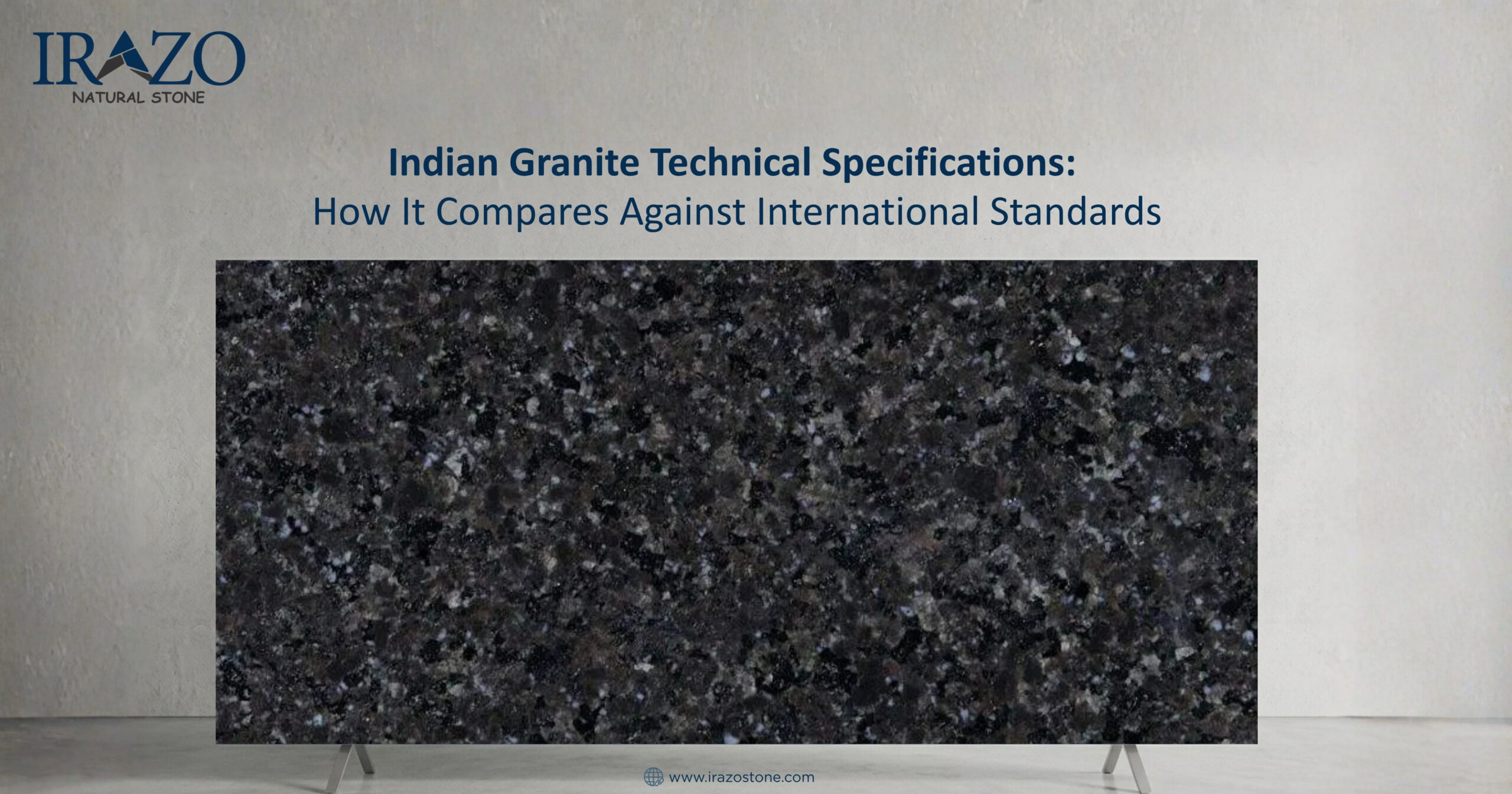
When it comes to choosing natural stone for construction, architecture, and large-scale infrastructure, granite remains one of the most trusted materials worldwide. Known for its durability, strength, and timeless aesthetic appeal, granite is used across residential, commercial, and international projects.
However, when it comes to international projects, one critical question always arises:
Does Indian granite meet global technical standards?
India stands as the world’s second-largest granite producer, contributing over 130 million tons annually to global markets. The country’s granite industry generates approximately $5 billion in export revenue, making it a cornerstone of India’s natural stone sector.
But what truly sets Indian granite apart is not just its availability, but its ability to meet and often exceed international technical specifications.
This comprehensive analysis explores the technical specifications, quality parameters, and performance characteristics that position Indian granite as a preferred choice over Brazilian, Chinese, Italian, and other global alternatives.
Understanding Granite: Technical Foundation
Granite is a coarse-grained igneous rock formed through slow crystallization of magma beneath Earth’s surface. The mineral composition typically includes orthoclase and plagioclase feldspars, quartz, hornblende, biotite, and muscovite, creating the distinctive interlocking crystalline structure that defines granite’s superior strength.
The average density of granite ranges from 2.75 g/cm³ with variations between 1.74 and 2.80, depending on mineral composition
Indian Granite: Technical Specifications Overview
Indian granite is widely recognized for its strong physical and mechanical properties, making it suitable for both domestic and international applications. Typically, it features a density between 2.6–2.8 g/cm³ and compressive strength ranging from 150–300 MPa, ensuring high load-bearing capacity. Its low water absorption (usually below 0.4% as per ASTM standards) enhances durability, while a Mohs hardness of 6–7 provides excellent resistance to wear. Additional properties like flexural strength (10–25 MPa) and low thermal expansion make it stable across varying environmental conditions.
In terms of quality compliance, Indian granite aligns with major global standards, including IS 14223:2023, ASTM, EN, and JIS, ensuring it meets international testing and performance benchmarks.
Regionally, Indian granite offers diverse technical strengths.
South Indian varieties such as Black Galaxy are known for low water absorption and dense composition, while stones like Kashmir White provide balanced strength and thermal resistance. Tan Brown stands out for its durability in high-traffic areas. In the northern region, Rajasthan granites like Jhansi Red and Crystal Yellow are valued for their strength, low porosity, and thermal stability.
To understand all types of granite, their technical specifications, applications, and region-wise differences in detail, check out our complete guide. Or feel free to contact us if you have any questions or need clarity on selecting the right granite for your project.
Indian Granite vs Brazilian Granite
| Property | Indian Granite | Brazilian Granite | Winner & Why |
| Density (kg/m³) | 2640–2680 | 2580–2750 | Tie – Overlapping ranges, both excellent |
| Water Absorption (%) | 0.38–0.56 | 0.22–0.407 | Brazilian – Slightly lower absorption |
| Compressive Strength (MPa) | 71–218 | 151–2607 | Brazilian – Higher maximum values |
| Grain Structure | Fine to medium | Medium to coarse | Indian – Better for polishing consistency |
| Color Variety | 200+ varieties | 50+ varieties | Indian – 4× more options |
| Block Availability | Large reserves | Good but selective | Indian – More consistent supply |
Performance Advantages
Indian Granite Benefits:
- Superior polish retention due to fine-grain structure
- Lower breakage risk during transportation and fabrication
- Consistent color matching across large installations
- More efficient export packaging and handling
Brazilian Granite Characteristics:
- Dramatic exotic patterns with bold color variations
- Premium pricing for unique varieties
- Limited availability for large-scale projects
- Higher transportation costs to Asian markets
Brazilian granite is actually good in some part but Indian granite is better in pure strength parameters. However, Indian granite offers better value, a wider variety, and a more consistent supply chain. Brazilian granite is technically superior but comes at a premium price.
Do you want a wide range of granite at very affordable pricing for your new home, office, or project?
Just contact us
With Irazo Stone – the best manufacturer of granite, you just send one message, and we handle the rest.
You can simply relax while your project gets the right material on time
Indian Granite vs Chinese Granite
| Feature | Indian Granite | Chinese Granite | Winner & Why |
| Density | Higher density, superior durability | Contains hairline cracks | Indian – Structural integrity guaranteed |
| Market Reputation | Globally trusted, with historical significance | Lower market confidence | Indian – Proven track record worldwide |
| Water Absorption (%) | 0.38–0.56 | 0.09–0.37 | Chinese – Lower absorption rates |
| Quality Certification | ASTM, BIS, CE compliant | GB standards primarily | Indian – More international certifications |
| Block Size Availability | Large consistent blocks | Variable block sizes | Indian – Better for major projects |
| Quality Control | Stringent testing protocols | Inconsistent quality standards | Indian – Reliable quality assurance |
| Compressive Strength (MPa) | 71–218 | 122–215.6 | Tie – Very similar ranges |
| Longevity | Proven 50+ year performance | Questionable long-term reliability | Indian – Documented durability |
Technical Deficiencies in Chinese Granite
Chinese granite often exhibits structural weaknesses that compromise performance:
- Invisible hairline cracks affect durability
- Inconsistent slab thickness variations
- Lower polish quality and retention
- Reduced resistance to weathering and thermal cycling
Why Indian Granite is Superior: The fundamental difference lies in structural integrity. Chinese granite’s hairline cracks create long-term reliability issues, while Indian granite’s dense, crack-free structure ensures decades of performance. Indian granite also offers better finishing quality and consistent thickness, making it the clear choice for professional installations.
Indian Granite vs Italian Granite
Cost-Performance Analysis
Italian Granite:
- Premium pricing (300-500% higher than Indian)
- Limited color variety
- Excellent finishing quality
- Strong brand recognition in luxury markets
Indian Granite:
- Superior value proposition
- Extensive color and pattern range
- Comparable technical performance
- Established global supply chain
Indian Granite vs Spanish Granite
| Property | Indian Granite | Spanish Granite (Galicia) | Winner & Why |
| Density (kg/m³) | 2640–2680 | 2580–2640 | Tie – Very similar ranges |
| Water Absorption (%) | 0.38–0.56 | 0.3–1.0 | Indian – More consistent, lower range |
| Flexural Strength (MPa) | 3.3–14.2 | 7.8–17.4 | Spanish – Higher maximum strength |
| Abrasion Resistance (mm) | 17–20 | 16.6–20.1 | Tie – Virtually identical |
| Freeze-Thaw Resistance | Good | Excellent | Spanish – Better cold climate performance |
| Color Variety | 200+ varieties | 30+ varieties | Indian – Much wider selection |
| Production Scale | Large-scale | Medium-scale | Indian – Better for bulk projects |
Both Indian and Spanish granite offer comparable technical performance, with strengths varying by application. However, Indian granite stands out overall due to its wider color variety, consistent quality, and strong suitability for large-scale projects.
Indian Granite vs Turkish Granite
| Aspect | Indian Granite | Turkish Granite | Winner & Why |
| Industry Experience | 50+ years | 20+ years | Indian – More mature industry |
| Technical Standards | IS 14223, ASTM compliant | EN standards developing | Indian – Established certifications |
| Quality Consistency | Variable by quarry | Improving but inconsistent | Indian – Better quality control systems |
| Production Capacity | 130 million tons/year | 15–20 million tons/year | Indian – 6x larger capacity |
| Global Market Share | 20% of world granite | 2–3% of world granite | Indian – Established market presence |
| Price Competitiveness | Highly competitive | Competitive | Tie – Similar pricing levels |
| Technical Innovation | Advanced processing | Modern equipment | Indian – More R&D investment |
The Turkish granite industry is rapidly improving but hasn’t yet matched India’s technical expertise, quality systems, or global market presence. Turkey offers competitive pricing but lacks the scale and experience.
Major Granite Export Ports in India and Their Capacity
India operates 13 major ports with specialized granite handling facilities. These ports play a key role in supporting large-scale exports. Major ports in India handle around 850 million tonnes of cargo annually, contributing to nearly 95% of the country’s total trade.
Primary Granite Export Ports
Chennai Port (Tamil Nadu)
- Annual granite exports: 2.5 million tonnes
- Container handling capacity: 1.5 million TEU
- Average dwell time: 3–4 days
- Direct shipping routes to 60+ countries
Visakhapatnam Port (Andhra Pradesh)
- India’s third-largest port by volume
- Handles around 81.09 million tonnes annually
- Equipped with 31 berths and Single Point Mooring facilities
- Granite handling capacity: 1.8 million tonnes annually
- 4 dedicated berths for stone cargo
- Strong rail connectivity to major quarry regions
Krishnapatnam Port (Andhra Pradesh)
- Privately operated port with modern infrastructure
- Granite handling capacity: 1.2 million tonnes annually
- Faster turnaround time: 2–3 days on average
Conclusion
Indian granite has proven itself as one of the most reliable and high-performing natural stones in the global market. From density and compressive strength to water absorption and durability, it consistently meets and often exceeds international standards like ASTM, EN, and BIS.
When compared with Brazilian, Chinese, Italian, Spanish, and Turkish granite, Indian granite offers the best balance of strength, consistency, availability, and cost. While some countries may perform slightly better in specific parameters, Indian granite stands out as the most practical and dependable choice for real-world applications.
If you are looking for high-quality granite that meets international standards and also fits your budget, choose Irazo Stone – the best granite manufacturer in India, offering premium quality, wide variety, and reliable supply for every project.
Whether it’s your home, office, or a large project, just share your requirement. With Irazo Stone, you send one message, and everything else is handled for you.