
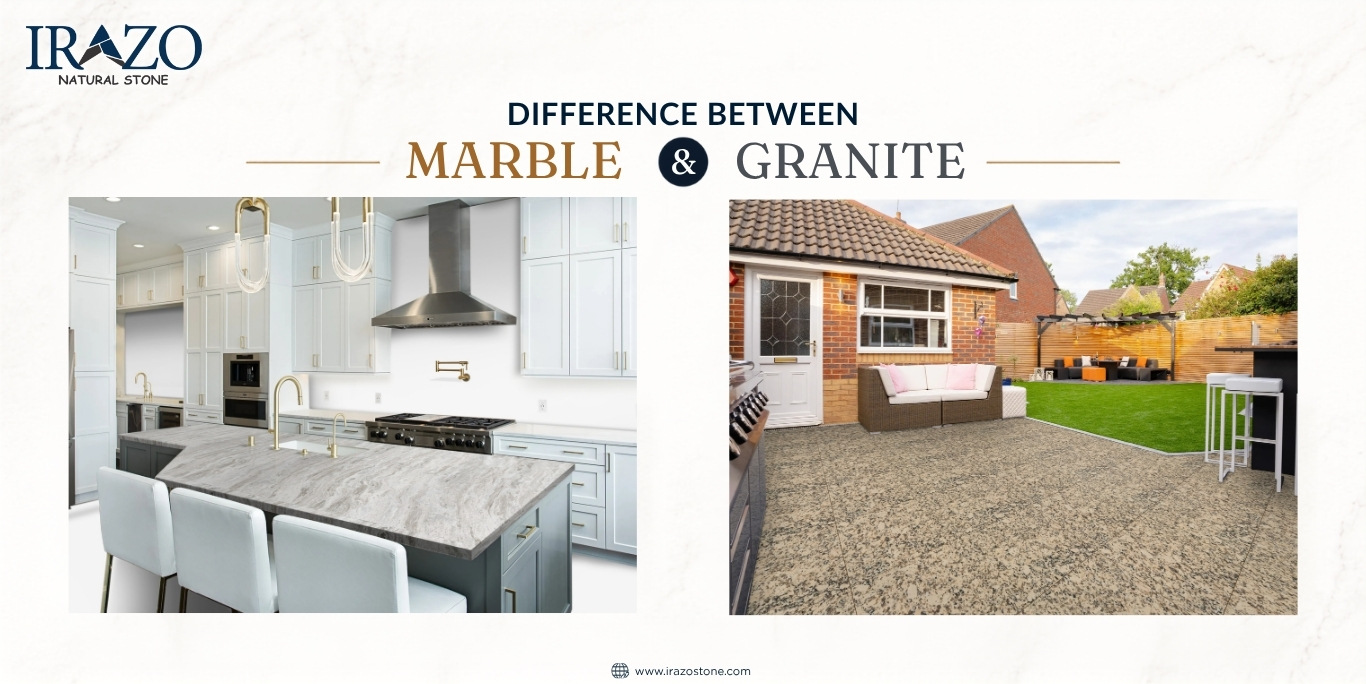
Natural stones like marble and granite bring beauty and strength to homes and buildings. Many people search for the difference between marble and granite when planning kitchens, bathrooms, floors, or other spaces. Both stones come from the earth and offer unique looks and strengths. Irazo Stone supplies high-quality marble and granite slabs from India, so you get reliable material for your projects.
This detailed guide explains everything in simple words. You will learn how each stone forms, their main features, how they look, how strong they are, how to care for them, where to use them, and more.
What Is Marble?
Marble forms when limestone, a sedimentary rock made mostly of calcium carbonate, faces intense heat and pressure deep in the earth over thousands of years. This process, called metamorphism, changes the limestone into marble with recrystallized calcite crystals.
Pure marble is usually white or light-colored. Impurities like iron or clay add shades of pink, gray, green, or black, often creating beautiful flowing veins. Marble feels smooth and has a somewhat softer surface compared to granite.
Key properties of marble:
- Hardness: Around 3 to 5 on the Mohs scale.
- Composition: Mainly calcium carbonate (calcite) or dolomite.
- Porosity: Moderate – it can absorb liquids if not sealed properly.
- Appearance: Elegant veins that look like natural art.
Marble gives a luxurious, timeless feel to any space. At Irazo Stone, we select the best marble blocks and process them with care in our modern units in Rajasthan and Andhra Pradesh.
Our marble slabs meet strict quality standards for consistent color and finish. Check our marble collection at Irazo Stone and find the perfect slabs for your next project.
What Is Granite? Origin and Basic Facts
Granite is an igneous rock that forms when molten magma cools slowly deep underground. This slow cooling creates large, visible crystals of minerals like quartz, feldspar, and mica.
Granite often shows a speckled or grainy pattern with dots and flecks of different colors. It comes in many shades – black, gray, pink, red, brown, and more. Each slab looks unique because of natural variations in minerals.
Key properties of granite:
- Hardness: 6 to 7 on the Mohs scale.
- Composition: Mostly quartz (20-60%), feldspar (65-90%), and smaller amounts of mica and other minerals.
- Porosity: Low – it resists water absorption better than marble when sealed.
- Appearance: Bold, speckled look with natural strength.
Granite is known for its toughness and long life. Irazo Stone operates advanced processing units to turn raw granite blocks into polished, high-quality slabs ready for export.
We ship more than 50 containers every month to happy clients worldwide. Browse our granite options and request a quote at Irazo Stone.
Difference between marble and granite
1. Formation Process: How Marble and Granite Are Born
The difference between marble and granite starts with how nature creates them.
Marble begins as limestone on the ocean floor. Over millions of years, heat from the earth’s interior and pressure from overlying rocks transform it. The calcite crystals grow larger and interlock, giving marble its ability to take a high polish.
Granite starts as magma from deep in the crust or upper mantle. When tectonic forces push this magma into cracks in the crust, it cools very slowly (sometimes over thousands of years). This creates coarse grains visible to the eye. Different minerals crystallize at different temperatures, leading to the speckled pattern.
2. Composition and Physical Properties
Marble is mostly calcium carbonate. This makes it react with acids (like lemon juice or vinegar), which can cause etching or dull spots. It has good compressive strength but scratches more easily than granite.
Granite contains silica-rich minerals like quartz and feldspar. These make it very hard and resistant to acids, scratches, and heat. Granite density is around 2.6-2.8 g/cm³, and it handles heavy use well.
Other differences:
- Weight: Both are heavy, but granite often feels denser.
- Thermal conductivity: Granite stays cooler; marble can feel slightly warmer.
- Sound: Marble rings when tapped; granite sounds more solid.
3. Appearance and Aesthetic Differences
Marble usually shows elegant, sweeping veins on a lighter background. It looks soft, classic, and luxurious – perfect for creating a calm, upscale atmosphere. Colors range widely, including pure whites with gray veins or dramatic greens and blacks.
Granite has a more varied, speckled or mottled look with visible mineral grains. Patterns can be busy or subtle depending on the variety. It offers bold, natural beauty that suits modern or traditional designs.
4. Hardness, Durability, and Strength Comparison
Granite wins in hardness and scratch resistance due to its quartz content. It handles daily kitchen use better and resists chipping.
Marble is softer, so it can develop a beautiful patina over time but needs more care to avoid scratches.
Both resist heat well, but granite performs better with hot pans. Marble can handle normal use if you use trivets. For high-traffic floors or heavy-duty areas, granite often lasts longer with less worry.
Real difference: Granite suits busy families; marble shines in lower-traffic elegant spaces.
5. Porosity, Stain Resistance, and Maintenance
Marble is more porous, so it absorbs spills faster and needs regular sealing (every 6-12 months). Clean with mild, pH-neutral soap and avoid acids.
Granite is less porous and more stain-resistant after sealing (every 1-2 years). It cleans easily and stands up to most household cleaners.
Tips for both:
- Wipe spills immediately.
- Use coasters and cutting boards.
- Re-seal as needed for long life.
Best Uses and Applications Of Granite and Marble
Granite is ideal for:
- Kitchen countertops
- Bathroom vanities
- High-traffic flooring
- Outdoor areas (with proper sealing)
- Fireplaces and outdoor kitchens
Marble excels in:
- Bathroom floors and walls
- Accent walls
- Luxury flooring in low-traffic areas
- Fireplaces and mantels
- Table tops and decorative pieces
Many projects mix both – granite in the kitchen and marble in the bathroom for the best of both worlds.
Irazo Stone supplies slabs perfect for all these uses, with options for polished, honed, or other finishes and custom edge profiles like bullnose or chamfer.
Conclusion
In conclusion, understanding the difference between marble and granite helps you select the perfect stone for your needs. Granite offers unmatched durability for busy areas, while marble brings timeless elegance to lighter-use spaces. Explore premium Indian marble and granite slabs at Irazo Stone.