
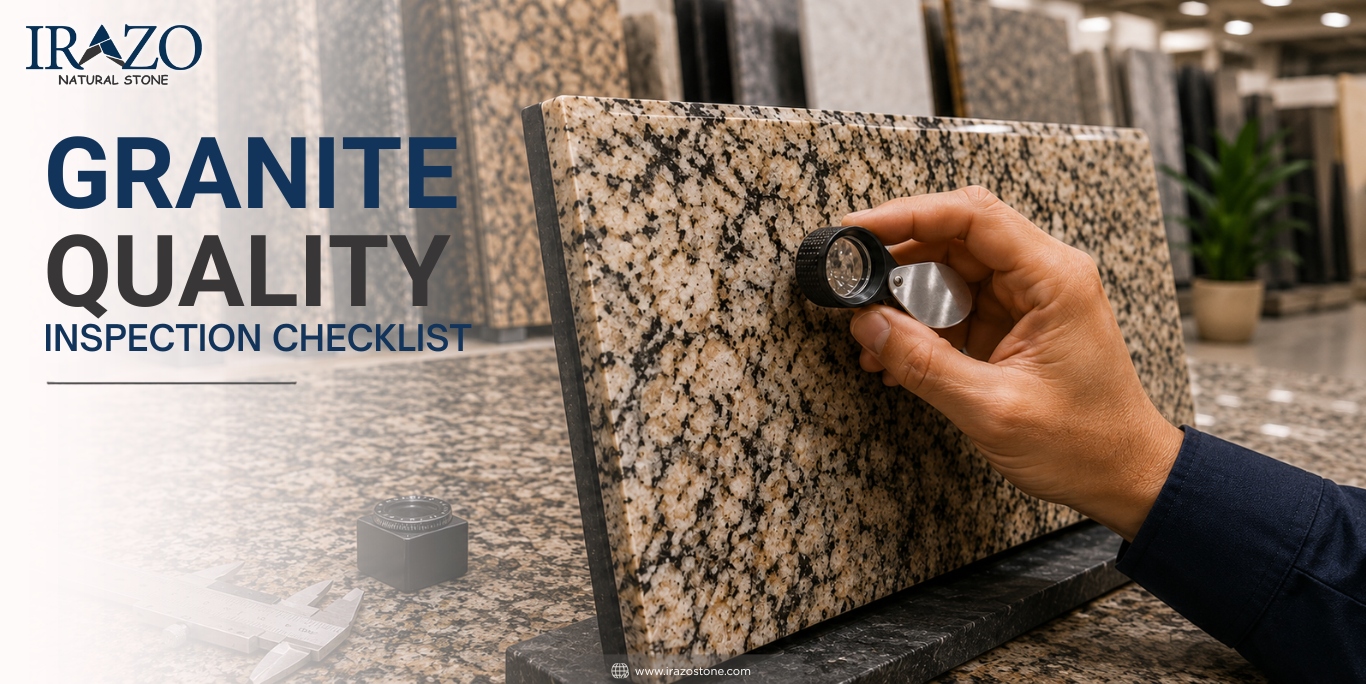
Granite stands as one of the toughest and most beautiful natural stones for homes and buildings. People use it for kitchen countertops, bathroom vanities, flooring, wall cladding, and outdoor spaces. But not all granite delivers the same performance. Poor-quality granite can crack, stain, fade, or break down quickly, leading to costly repairs. A proper granite quality inspection checklist helps you avoid these problems and choose stone that lasts for decades.
This detailed guide covers everything you need to know about inspecting granite quality, from raw blocks to finished slabs. Use this checklist whether you buy for a small home project or large commercial work. It will help you make smart choices and get the best value.
Why Granite Quality Inspection Matters?
Granite forms deep in the earth from cooled magma, giving it natural strength. Yet, variations in mineral content, quarrying, cutting, and finishing affect the final product. Weak spots, hidden cracks, or high porosity can cause issues years later.
A good inspection catches problems early. It saves money on replacements and keeps your space looking great. Builders, architects, and homeowners who follow a systematic granite quality inspection checklist get consistent results. Exporters like Irazo Stone follow these checks to ensure every slab ships in top condition.
Key benefits of thorough inspection:
- Longer lifespan of the installed stone
- Better resistance to stains, scratches, and heat
- Uniform appearance across large areas
- Compliance with building codes and buyer expectations
- Peace of mind for your investment
Irazo Stone applies these principles daily. Our team inspects every batch before packing, which is why clients across the world trust us for reliable granite supplies.
Understanding Granite Grades and Types
Granite comes in different grades based on color consistency, pattern, strength, and finish. While exact grading systems vary by supplier, common categories include:
- Premium/First Quality: Even color, minimal variation, few natural features, excellent polish.
- Standard/Commercial: Good overall quality with some natural variations in color and pattern.
- Economy/Second Quality: More variations, possible minor defects, suitable for less visible areas.
Indian granite, such as Black Galaxy, Absolute Black, Imperial Red, or Kashmir White, varies by quarry location. Each type has unique characteristics that affect inspection.
During inspection, match the grade to your project needs. Countertops often need higher grades for uniformity, while flooring might accept slight variations for a natural look.
Step-by-Step Granite Quality Inspection Checklist
1. Source and Documentation Verification
Start at the beginning. Ask for:
- Quarry origin details
- Material test reports (if available)
- Batch numbers and photos of the actual lot
- Export documents for international buyers
Reputable suppliers like Irazo Stone provide clear documentation. This ensures traceability and consistency.
2. Visual Inspection for Surface Defects
Lay slabs flat or stand them upright under good lighting.
- Check for cracks, fissures, or chips on the face and edges.
- Look for pits, holes, or cavities that could trap dirt.
- Examine color uniformity within and across slabs.
- Inspect polish quality: It should be even, mirror-like for polished finishes, without dull spots or orange peel texture.
- Verify pattern consistency for book-matched or vein-matched projects.
Natural variations exist, but excessive defects indicate lower quality. Run your hand over the surface, it should feel smooth.
3. Dimensional Accuracy and Thickness Check
Measure multiple points on each slab:
- Length and width tolerances (usually ±1mm or better)
- Thickness: Common export sizes are 18- 20 mm or 30mm. Check consistency—variation should stay within ±1mm.
- Edge straightness and squareness: Use a square tool. Diagonals should match for rectangular slabs.
- Flatness: Place a straight edge across the surface; gaps should be minimal.
Uneven thickness causes installation problems and weak spots. Irazo Stone uses calibrated machinery for precise dimensions.
4. Water Absorption Test (Porosity Check)
This simple test shows how well the stone resists stains.
- Pour a few drops of water on the surface.
- High-quality granite absorbs slowly or beads up. Quick absorption means higher porosity and stain risk.
- Ideal absorption rate is below 0.4% (per ASTM C97).
Wipe the water after 10-15 minutes. No dark spots should remain on good stone. Sealants help, but dense granite needs less maintenance.
Our granite at Irazo Stone shows low absorption due to tight grain structure.
5. Hardness and Scratch Test
Granite ranks high on the Mohs scale (6-7).
- Try scratching with a steel knife or coin. Quality granite resists marks.
- Tap with a lightweight hammer or metal object. A clear ringing sound indicates solid stone; a dull thud suggests cracks or voids.
6. Chemical Resistance Test
Kitchen granite faces acids from food and cleaners.
- Apply lemon juice or vinegar for 15-30 minutes.
- No etching, dulling, or discoloration should occur on quality stone.
7. Edge and Finish Quality
- Edges should be straight and uniform.
- Check profiles like bullnose, bevel, or ogee for smoothness.
- Surface finishes (polished, honed, flamed, leathered) must be consistent.
Irazo Stone offers various edge profiles and finishes with precise craftsmanship.
8. Strength and Durability Indicators
Look for:
- High density and weight (dense stone feels heavier).
- No signs of resin overfill hiding defects.
- Compliance with standards like ASTM C170 (compressive strength), C880 (flexural strength).
9. Packing and Shipping Inspection (For Buyers/Importers)
- Slabs should have proper separators and protection.
- Crates must be sturdy and labeled correctly.
- Check for damage during loading.
10. Post-Installation Checks
- Level and alignment of joints.
- Proper sealing and grouting.
- No lippage between pieces.
- Clean surfaces without residue.
Detailed Granite Quality Standards and Testing
Professional testing uses ASTM methods:
- ASTM C97: Absorption and density.
- ASTM C170: Compressive strength.
- ASTM C880: Flexural strength.
- ASTM C241/C1353: Abrasion resistance.
These ensure the stone performs under load, traffic, and weather. Irazo Stone follows strict internal protocols aligned with these global standards.
Granite Inspection for Specific Applications
Countertops
Focus on stain resistance, thickness (3cm preferred), and heat tolerance. Uniform color matters for visible areas.
Flooring
Check slip resistance (honed or flamed finishes), abrasion resistance, and consistent thickness for level installation.
Wall Cladding and Exterior
Prioritize flexural strength and weather resistance.
Commercial Projects
Require batch consistency and full documentation.
Tailor your checklist to the use case.
Maintenance Tips to Preserve Granite Quality
Even the best granite needs care:
- Seal periodically (frequency depends on porosity).
- Clean with pH-neutral products.
- Avoid harsh chemicals.
- Use coasters and trivets.
- Wipe spills quickly.
Proper care extends the life of your investment.
Final Thoughts
A thorough granite quality inspection checklist protects your project and budget. By checking visuals, dimensions, absorption, hardness, and documentation, you choose a stone that performs beautifully for years.
Natural stone, like granite, offers timeless appeal when selected and installed correctly. Avoid shortcuts—inspect carefully and work with trusted partners like Irazo Stone.