
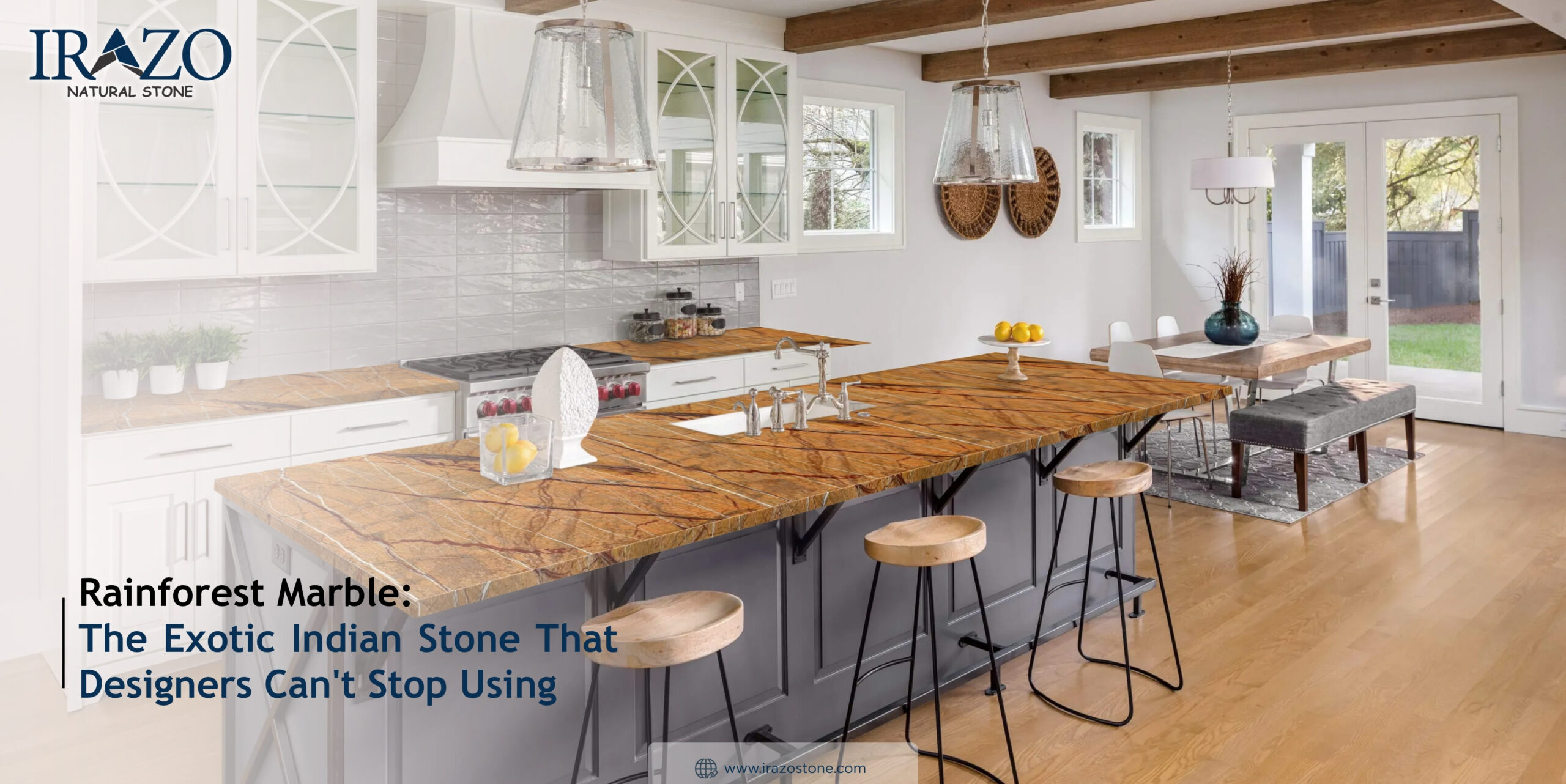
Rainforest Marble brings the beauty of nature indoors. Its green, brown, and gold patterns look like forest scenes with flowing veins and earthy tones. Quarries in Rajasthan, India, produce this unique marble that designers love for modern and warm spaces.
This guide covers what Rainforest Marble is, its features, popular types, uses, and why it stands out. Learn how to choose and use it for your projects.
What Is Rainforest Marble
Rainforest Marble is a natural stone with dramatic patterns that remind people of lush forests. It forms over millions of years with minerals that create green bases and brown or gold veins. Mines in Rajasthan, especially around Bidasar and Keshariyaji, yield the best material.
Unlike plain white marbles, it offers movement and color variation that makes every piece different. This natural look appeals to those who want something special.
Irazo Stone selects blocks with strong patterns and processes them into beautiful finished products.
Key Features and Properties of Rainforest Marble
1. Rich Green Base with Natural Veining
Rainforest Marble typically features a deep green background interwoven with brown, black, and sometimes golden veins. These veins resemble tree roots or forest branches, which is why the stone is often called “Rainforest” marble. The patterns are completely natural, meaning no two slabs are identical. This makes it a preferred choice for feature walls and decorative surfaces where visual impact is important.
2. Moderate to Good Hardness and Density
Compared to softer marbles, Rainforest Marble offers moderate hardness and decent density, making it suitable for regular interior use. While it is not as hard as granite, it performs well in low to medium traffic areas such as living rooms, bedrooms, and wall cladding. Proper installation and support are important because some variants may have natural fissures due to their veining structure.
3. Excellent Polish Retention
Rainforest Marble can take a high-quality polish, resulting in a smooth and glossy surface that enhances its natural colors and patterns. It is also available in honed or matte finishes for a more subtle look. With proper maintenance, the polished surface retains its shine for a long time, especially in indoor environments.
4. Natural Variation and Unique Aesthetic
One of the defining properties of Rainforest Marble is its high level of variation. Each slab has different vein intensity, color tones, and pattern flow. This natural variation adds depth and character, making large surfaces like walls or floors look more dynamic and artistic rather than uniform.
5. Porosity and Sealing Requirement
Like most marbles, Rainforest Marble has moderate porosity. It can absorb liquids if left unsealed, which may lead to staining over time. Therefore, proper sealing is essential before and after installation, especially in areas exposed to moisture. Regular resealing helps maintain both appearance and durability.
6. Best Suited for Interior Applications
Due to its structure and porosity, Rainforest Marble is mainly recommended for interior use. It is widely used for wall cladding, decorative panels, tabletops, bathroom walls, and low-traffic flooring. It is not typically preferred for heavy-duty outdoor use or high-traffic commercial flooring without special treatment.
7. Structural Characteristics
Some types of Rainforest Marble (especially Green Rainforest) may contain natural cracks or resin-filled lines, which are part of the stone’s formation. These do not necessarily reduce its usability but require careful handling during cutting and installation. Professional processing ensures better strength and finish.
Popular Varieties of Rainforest Marble
Mines produce several types:
- Rainforest Green: Deep green with dramatic brown and black veins — the most popular.
- Rainforest Brown: Earthy brown tones with lighter accents.
- Rainforest Gold: Golden hues mixed with green for brighter looks.
Each variety offers different moods. Green feels fresh while brown gives a grounded feeling.
Why Designers Love Rainforest Marble
Designers choose it because:
- Unique patterns create focal points in any space.
- Earthy colors pair well with wood, metal, and neutral tones.
- Natural look fits biophilic design trends that connect people with nature.
- Versatility for floors, walls, and countertops.
- Ability to make small rooms feel bigger with flowing patterns.
It appears in luxury homes, hotels, restaurants, and offices where people want something beyond plain stone.
Common Uses of Rainforest Marble
- Flooring in living areas and lobbies
- Wall cladding for feature walls
- Kitchen and bathroom countertops
- Tabletops and furniture accents
- Bathroom vanities and shower walls
- Exterior accents in suitable climates
It adds depth to any surface. Book-matching slabs creates mirror patterns for dramatic effect.
How to Choose Quality Rainforest Marble
Look for:
- Consistent thickness and good polish.
- Strong, clear patterns without weak spots.
- Low porosity for better performance.
- Reliable supplier with clear origin information.
Request samples and photos of actual stock.
Conclusion
Rainforest Marble stands out as an exotic Indian stone that adds life and movement to designs. Its unique patterns, earthy colors, and versatility explain why designers keep using it in top projects.
Whether you plan a home, hotel, or commercial space, this marble creates lasting impressions. Choose quality material from experienced suppliers for best results.
Irazo Stone offers premium Rainforest Marble processed with care. We help turn your ideas into beautiful finished work.